

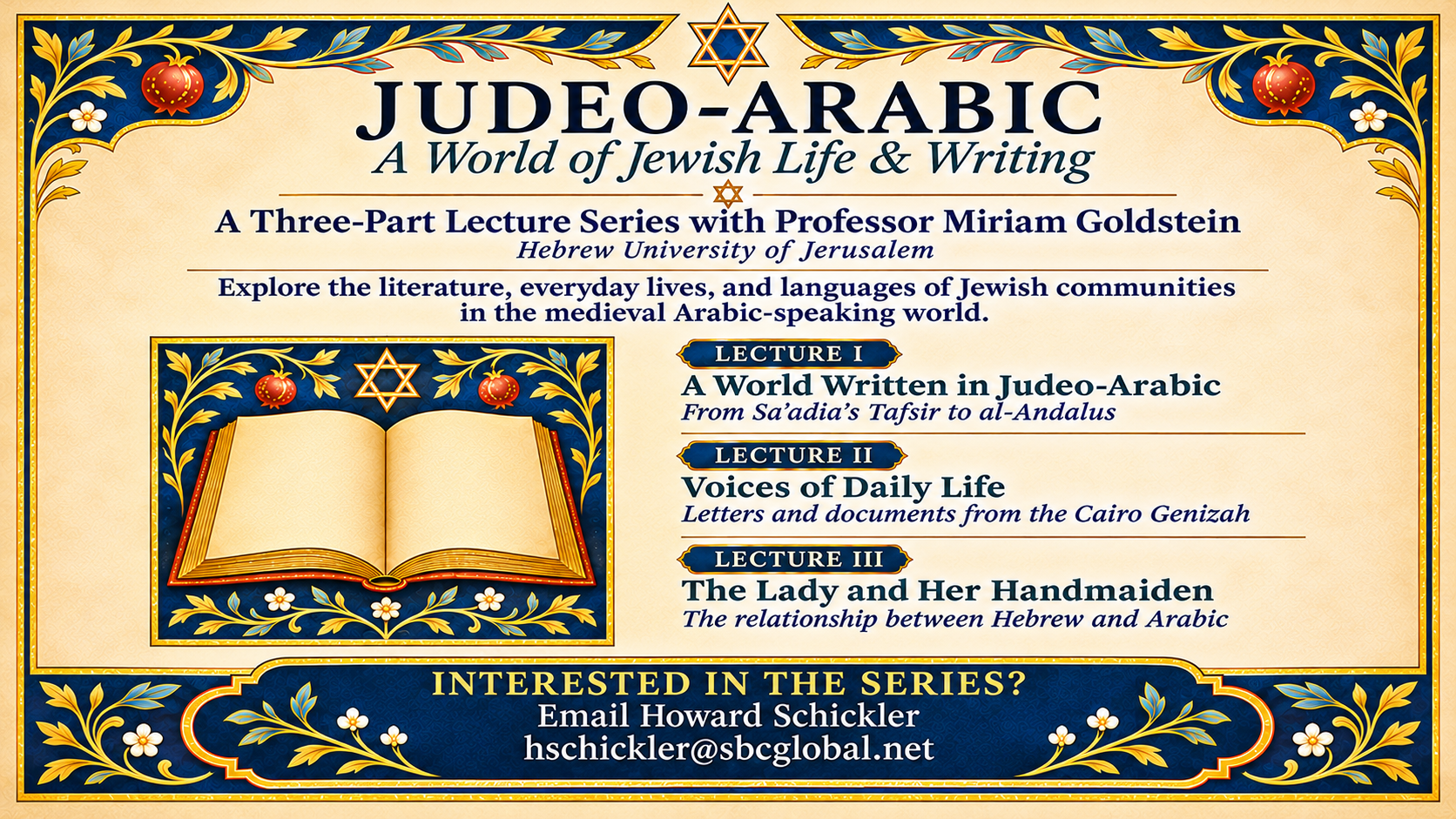
As some of you know, Howard Schickler, our tour guide, has long been interested in Jewish life under Islam in the Medieval period. What he did not know was that this was the world in which 90 percent of the world’s Jews lived and a world where, like with us today for English, Arabic had become the everyday language of most Jews, to the extent that while they could read the Torah in Hebrew, they needed a translation into Arabic to understand the text.
What developed was Judeo-Arabic, Arabic words written in Hebrew letters. He was surprised to learn that Maimonides Guide to the Perplexed and other major works were written in Judeo-Arabic, which suggests to Howard that Maimonides’ audience was exclusively Jewish people who understood Arabic AND could read the Hebrew letters.
This series will explore some of the most important works created in the centuries when Arabic was the everyday language of most Jewish communities. Our path will take us from the great literary works used in religious life to the patchwork of Judeo-Arabic texts that filled the daily routine. Along the way, we’ll gain a clearer sense of how deeply this Judeo-Arabic world shaped Jewish history and writing. We’ll conclude by looking at the relationship between Hebrew and Arabic, and the roles each played in this fascinating period.
Lecture I: A World Written in Judeo-Arabic: From Sa’adia’s Tafsir to al-Andalus
From Miriam Goldstein, the series lecturer:
One of the most influential works ever written in Judeo-Arabic is the Torah translation, or Tafsir, of Rabbi Sa‘adia Gaon (d. 942). This work was groundbreaking – it gave Jewish communities a way to read the Torah in their everyday language and set the model for how Arabic could be written in Hebrew letters. In this session, we’ll meet Sa‘adya himself, explore his Tafsir, and place it alongside his other writings and the world in which he lived.
Lecture II: Voices of Daily Life
Learning about everyday life using Judeo-Arabic is possible on the basis of letters and documents from the Cairo Genizah. We will meet and even “hear” Jewish women and men who lived more than a millennium ago, listening to what they cared about, what they wrote about, and what they read. Through their voices, we will gain understanding of the Jews of the time, of the varied Mediterranean region and of medieval history.
Lecture III: The Lady and her Handmaiden
Jews who spoke Arabic every day had a unique relationship with Hebrew, the language of their prayers and Scriptures. We’ll see how Arabic opened new ways of understanding the Bible, and how some writers even imagined the two languages in rivalry with one another. We’ll read Hebrew poems composed in the language of the Bible, but shaped by Arabic style and images, and we will follow the story of how, in the later medieval period, Jewish scholars – even those who were bilingual – gradually shifted from Judeo-Arabic back toward Hebrew.
The presentations are by Professor Miriam Goldstein
I am Professor of Arabic at the Department of Arabic Language and Literature at the Hebrew University of Jerusalem, where I research and teach the cultural, intellectual, and literary history of the Jews in the Mediterranean and Near East, on the basis of Judeo-Arabic, Arabic and Hebrew texts. I hold degrees from Harvard College (A.B., Near Eastern Literatures and Civilizations) and the University of Cambridge (M.Phil, Oriental Studies) as well as a PhD from the Hebrew University of Jerusalem. My current research focuses on the Karaite scholar Yaʿqūb al-Qirqisānī in his rich and cosmopolitan context of tenth-century Baghdad, as well as on the long and colorful history of Toledot Yeshu, a counter-historical narrative composed by Jews in Late Antiquity and transmitted until the present.
IF YOU ARE INTERESTED IN THIS SERIES PLEASE LET HOWARD KNOW BY EMAIL (hschickler@sbcglobal.net). This will allow Howard to share any related materials he finds. The lectures are complete by themselves, so reading any such materials is not necessary.